Cambridge IGCSE Physics 0625
Chapter 2.3
Transfer of Thermal Energy
Detailed Core and Extended notes on conduction, convection, infrared radiation, experiments and applications of thermal energy transfer.
Syllabus coverage
Syllabus Checklist
Core You should be able to:
2.3.1 Conduction
- Describe experiments that demonstrate the properties of good thermal conductors and bad thermal conductors, also called thermal insulators.
2.3.2 Convection
- Know that convection is an important method of thermal energy transfer in liquids and gases.
- Explain convection in liquids and gases in terms of density changes and describe experiments that illustrate convection.
2.3.3 Radiation
- Know that thermal radiation is infrared radiation and that all objects emit this radiation.
- Know that thermal energy transfer by thermal radiation does not require a medium.
- Describe the effects of surface colour and texture on the absorption, emission and reflection of infrared radiation.
2.3.4 Consequences of thermal energy transfer
- Explain basic everyday applications and consequences of conduction, convection and radiation, including heating a kitchen pan and heating a room by convection.
Extended Core plus Supplement:
2.3.1 Conduction
- Describe conduction in all solids using atomic or molecular lattice vibrations and, in metals, the movement of free delocalised electrons.
- Describe, using particles, why thermal conduction is poor in gases and most liquids.
- Know that some solids conduct thermal energy better than thermal insulators but less well than good thermal conductors.
2.3.2 Convection
There are no separate Supplement points for this subsection.
2.3.3 Radiation
- Know that an object remains at constant temperature when it transfers energy away at the same rate that it receives energy.
- Know what happens when the rate at which an object receives energy is greater or less than the rate at which it transfers energy away.
- Know that the Earth's temperature is affected by factors controlling the balance between incoming radiation and radiation emitted from the Earth's surface.
- Describe experiments that distinguish between good and bad emitters of infrared radiation.
- Describe experiments that distinguish between good and bad absorbers of infrared radiation.
- Describe how the rate of radiation emission depends on surface temperature and surface area.
2.3.4 Consequences of thermal energy transfer
- Explain applications and consequences in which more than one method of thermal energy transfer is significant, including a fire burning wood or coal and a radiator in a car.
Essential language
Definitions
Conduction
Thermal energy transfer through a material without overall movement of the material.
Thermal conductor
A material that transfers thermal energy readily. Metals are usually good thermal conductors.
Thermal insulator
A material that transfers thermal energy slowly. It is also called a bad thermal conductor.
Convection
Thermal energy transfer by the movement of warmer and cooler regions of a liquid or gas.
Convection current
A continuous circulation caused when warmer, less dense fluid rises and cooler, denser fluid sinks.
Thermal radiation
Infrared electromagnetic radiation emitted by all objects because of their temperature.
Infrared radiation
An electromagnetic wave that transfers energy and does not require particles or a medium.
Delocalised electron
An electron in a metal that is free to move through the lattice and transfer energy rapidly.
Emitter
A surface or object that transfers energy to its surroundings by emitting infrared radiation.
Absorber
A surface or object that receives energy by absorbing incident infrared radiation.
Energy balance
The comparison between the rate at which an object receives energy and the rate at which it transfers energy away.
Medium
A substance through which energy is transferred. Conduction and convection require matter, but radiation does not.
Core
Core Notes
2.3.1 Conduction
Conduction transfers thermal energy through a material without an overall movement of the material. Energy is transferred from a region at a higher temperature to a region at a lower temperature.
Metals such as copper and aluminium are good thermal conductors. Materials such as wood, plastic, glass, wool and trapped air are much poorer conductors and are commonly used as thermal insulators.
Comparing a metal and wooden spoon
If a metal spoon and a wooden spoon are placed in hot water, the handle of the metal spoon becomes hot more quickly. Thermal energy is conducted through the metal more rapidly than through the wood.
This does not mean that the metal produces thermal energy. Both spoons receive energy from the hot water, but the metal transfers it along the spoon at a greater rate.
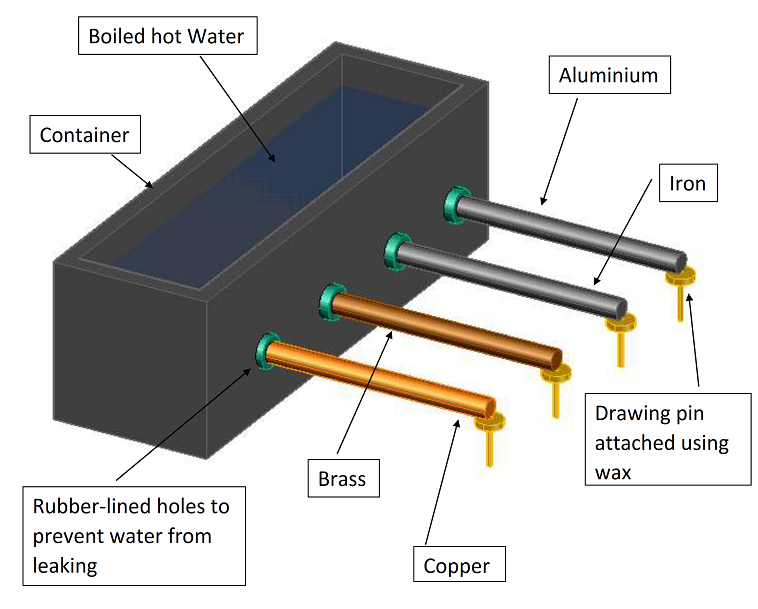
Experiment: comparing thermal conductors
This experiment compares different rods to determine which material is the best thermal conductor.
- Select rods made from different materials. The rods should have the same length and cross-sectional area so that the comparison is fair.
- Insert each rod by the same distance through rubber-lined holes in the side of a container.
- Attach a drawing pin to the outer end of each rod using the same mass of wax.
- Fill the central container with boiling water and start a stopwatch.
- Record the time taken for the wax on each rod to melt and for its drawing pin to fall.
- Repeat the experiment and calculate a mean time if possible.
Thermal energy is conducted from the hot water along each rod. The rod whose pin falls first transfers energy at the greatest rate and is therefore the best thermal conductor.
2.3.2 Convection
Convection is an important method of thermal energy transfer in liquids and gases. Liquids and gases are called fluids because they can flow.
Convection involves the movement of the fluid itself. It does not occur in solids because particles in a solid cannot move freely from one place to another.
Formation of a convection current
- A region of liquid or gas is heated.
- The heated fluid expands.
- The same mass now occupies a larger volume, so its density decreases.
- The warmer, less dense fluid rises.
- Cooler, denser fluid moves down to replace it.
- The cooler fluid is then heated and rises.
- This continuous circulation forms a convection current.
As the warmer fluid rises, it transfers thermal energy to other regions. When it cools, its density increases and it may sink again.
Experiment: convection currents in air
- Use a box with two glass chimneys in its top.
- Place a lit candle below one chimney.
- Hold smoking touch paper above the other chimney.
- Observe the direction in which the smoke moves.
Air heated by the candle expands, becomes less dense and rises through the chimney above the candle. Cooler air is drawn down the other chimney to replace it. The smoke makes this movement visible.
The smoke travels down one chimney, across the box and out through the chimney above the candle. This demonstrates a convection current in air.
Convection in a liquid
A small crystal of potassium manganate(VII) or another coloured material can be placed near the bottom of a beaker of water. When the water is heated gently near the crystal, the coloured water shows the movement of the convection current.
Water above the heater warms, expands, becomes less dense and rises. Cooler, denser water sinks elsewhere in the beaker to replace it.
2.3.3 Radiation
Thermal radiation is infrared radiation
All objects emit thermal radiation. Thermal radiation is infrared electromagnetic radiation.
An object does not need to be glowing before it emits infrared radiation. A person, a table and the walls of a room all emit infrared radiation because they have temperatures above absolute zero.
Hotter objects emit infrared radiation at a greater rate than cooler objects. Very hot objects may also emit visible light, but their thermal energy transfer still includes infrared radiation.
Radiation does not require a medium
Infrared radiation can travel through a vacuum. It does not require air, water or any other material medium.
This is different from conduction and convection, which depend on particles. Energy from the Sun reaches the Earth through the vacuum of space by electromagnetic radiation.
Effect of surface colour and texture
| Surface | Absorption | Emission | Reflection |
|---|---|---|---|
| Dull black | Very good absorber | Very good emitter | Poor reflector |
| Dull white | Poorer absorber than black | Poorer emitter than black | Good reflector |
| Shiny silver or polished metal | Poor absorber | Poor emitter | Very good reflector |
Dull black surfaces are the best absorbers and emitters of infrared radiation. Shiny, light-coloured or polished surfaces are generally poor absorbers and emitters but good reflectors.
A good absorber is also a good emitter. A poor absorber is also a poor emitter and is usually a good reflector.
2.3.4 Everyday applications and consequences
Heating food in a kitchen pan
The base of a kitchen pan is made from a good thermal conductor such as aluminium, copper or steel. Thermal energy is conducted from the cooker through the pan and into the food.
The pan base is often wide to increase the area available for energy transfer. A thick, flat base can also spread energy more evenly and reduce hot spots.
The handle is commonly made from a thermal insulator such as plastic, wood or silicone. This reduces conduction from the hot pan to the user's hand.
Heating a room by convection
A room heater or radiator warms the nearby air. The warmed air expands, becomes less dense and rises. Cooler, denser air moves towards the heater and is warmed in turn.
The resulting convection current circulates warmer air around the room. A heater is often placed near the floor because warm air rises. Placing it high on a wall would leave a larger amount of cooler air near the floor.
The term radiator is slightly misleading for a household radiator because much of the energy is transferred to the room by convection, although infrared radiation also contributes.
Supplement material
Extended Notes
These notes add the Supplement content. The Core notes above are not repeated.
Thermal conduction in solids
Lattice vibrations
Particles in a solid are held in a lattice or fixed arrangement. They vibrate continuously about their equilibrium positions.
When one end of a solid is heated, particles in that region gain kinetic energy and vibrate more vigorously. They interact with neighbouring particles and transfer some of their kinetic energy to them.
These neighbouring particles then vibrate more vigorously and transfer energy to particles farther along the solid. Thermal energy is therefore transferred through the lattice from the hotter region to the cooler region.
This mechanism occurs in all solids, including metals and non-metals.
Free electrons in metals
Metals contain free or delocalised electrons that can move throughout the lattice. These electrons gain kinetic energy in the hotter region and move rapidly through the metal.
The electrons collide with ions and other electrons, transferring energy quickly to cooler parts of the metal. Metals therefore conduct thermal energy using both lattice vibrations and free electrons.
The additional electron mechanism is why metals are generally much better thermal conductors than non-metallic solids.
Why gases and most liquids are poor conductors
In gases, particles are widely separated. Collisions are less frequent than in solids, so energy is transferred slowly from one particle to another.
Particles in liquids are closer together than particles in gases, but they are not held in a regular lattice and most liquids do not contain free delocalised electrons. Thermal energy transfer by conduction is therefore generally slower than in metals.
Convection often transfers energy more effectively than conduction in liquids and gases because the warmer fluid itself moves.
Intermediate thermal conductors
Materials cannot always be classified simply as perfect conductors or perfect insulators. There is a continuous range of thermal conductivities.
Some solids, including glass and ceramics, conduct thermal energy better than materials such as wool, foam or trapped air but less effectively than good metallic conductors such as copper and aluminium.
A material may therefore be a better conductor than a thermal insulator while still being a much poorer conductor than a metal.
Energy balance and constant temperature
An object can receive energy and transfer energy away at the same time. Its temperature depends on the balance between these rates.
The object's internal energy remains constant, so its temperature remains constant.
The object's internal energy increases, so its temperature generally rises.
The object's internal energy decreases, so its temperature generally falls.
An object at constant temperature is not necessarily receiving no energy. It may be receiving energy continuously while transferring energy away at the same rate.
The Earth's radiation balance
The Earth receives energy mainly from the Sun. Some incoming solar radiation is reflected back into space by clouds, the atmosphere, ice, water and the Earth's surface. The remainder is absorbed.
The warmed Earth emits infrared radiation towards space. The average temperature of the Earth depends on the balance between absorbed incoming radiation and outgoing infrared radiation.
- Cloud cover: clouds can reflect incoming radiation and can also absorb and re-emit outgoing infrared radiation.
- Ice and surface reflectivity: light-coloured ice reflects more incoming radiation than darker land or ocean.
- Greenhouse gases: gases such as carbon dioxide, methane and water vapour absorb some outgoing infrared radiation and re-emit it in different directions.
- Changes in land and vegetation: these can alter how much incoming radiation is reflected or absorbed.
If the Earth receives energy faster than it emits energy, its average temperature increases. If it emits energy faster than it receives energy, its average temperature decreases.
Experiment: comparing infrared emitters
This experiment compares a dull black surface with a shiny polished surface.
- Use a copper sheet with one dull black surface and one polished surface.
- Heat the sheet so both surfaces reach the same temperature.
- Place identical infrared detectors at equal distances from each surface. If detectors are unavailable, hands may show a qualitative difference but must not touch the hot sheet.
- Compare the detector readings from the two surfaces.
The detector facing the dull black surface gives the greater reading. The dull black surface emits infrared radiation at a greater rate than the shiny polished surface.
Experiment: comparing infrared absorbers
This experiment compares the absorption of infrared radiation by a dull black surface and a shiny surface.
- Use two identical metal sheets. Give one sheet a dull black surface and leave the other polished and shiny.
- Attach identical drawing pins or coins to the back of the sheets using equal masses of wax.
- Place the sheets at equal distances from an infrared heater, with their prepared surfaces facing the heater.
- Switch on the heater and start a stopwatch.
- Record the time taken for the wax on each sheet to melt and for the pin or coin to fall.
The wax on the dull black sheet melts first because the dull black surface absorbs infrared radiation at a greater rate. The shiny surface reflects more radiation and absorbs less.
Rate of infrared emission
Surface temperature
An object with a higher surface temperature emits infrared radiation at a greater rate. As an object becomes hotter, it transfers more energy each second by radiation.
The rate of net energy transfer also depends on the difference between the object's temperature and the temperature of its surroundings. A hot object in cool surroundings loses energy more rapidly than the same object in warmer surroundings.
Surface area
A larger surface area can emit infrared radiation from a greater area. At the same surface temperature and with the same surface finish, increasing surface area increases the total rate of energy emission.
This is why radiators and cooling fins often have large surface areas.
Fire burning wood or coal
Several methods of thermal energy transfer operate at the same time around a fire.
- Conduction: energy is conducted through solid pieces of wood or coal and through metal objects touching the fire.
- Convection: air and combustion gases are heated, expand, become less dense and rise. Cooler air moves towards the fire, supplying oxygen and forming convection currents.
- Radiation: flames, glowing fuel and hot surfaces emit infrared radiation. This transfers energy directly to people and objects without requiring contact.
A person can feel infrared radiation from the side of a fire even though convection mainly carries hot air upwards.
Radiator in a car
A car radiator transfers unwanted thermal energy from the engine coolant to the surrounding air.
- Coolant absorbs energy from the engine and flows to the radiator.
- Thermal energy is conducted from the hot coolant through the metal tubes of the radiator.
- Thin metal fins conduct energy away from the tubes and provide a large surface area.
- Air moving over the fins receives energy. Forced airflow from a fan and the car's motion increases convection.
- The warmed air is carried away and replaced by cooler air.
- The radiator also emits infrared radiation, although conduction and convection are usually more significant.
The large surface area of the fins and continuous airflow increase the rate at which energy is transferred away from the coolant.
Exam practice
Practice Questions
Question 1
Describe an experiment that compares the thermal conductivity of four different metal rods.
- Use rods with equal lengths and cross-sectional areas.
- Attach identical pins using equal masses of wax.
- Heat equal lengths of the rods using boiling water under identical conditions.
- The rod whose pin falls first is the best thermal conductor.
Question 2
Explain how a convection current forms when water is heated from below.
- The water near the heater warms and expands.
- Its density decreases.
- The warmer water rises while cooler, denser water sinks to replace it.
- The continuing circulation transfers thermal energy and forms a convection current.
Question 3
Compare a dull black surface with a shiny silver surface as an absorber, emitter and reflector of infrared radiation.
- A dull black surface is a good absorber and good emitter.
- A shiny silver surface is a poor absorber and poor emitter.
- A shiny silver surface is a good reflector, while a dull black surface is a poor reflector.
Question 4
Explain why metals conduct thermal energy better than most non-metallic solids.
- In every solid, particles in the hotter region vibrate more vigorously.
- They transfer energy to neighbouring particles through lattice interactions.
- Metals also contain free delocalised electrons.
- These electrons move through the lattice and transfer energy rapidly by collisions.
Question 5
An object receives energy at 80 J/s and transfers energy away at 55 J/s. State and explain what happens to its temperature.
Rate of energy gain: 80 − 55 = 25 J/s.
The object receives energy faster than it transfers energy away. [1]
Its internal energy increases. [1]
Its temperature therefore rises. [1]
Question 6
Explain how a car radiator transfers thermal energy from hot engine coolant to the surroundings.
- Hot coolant flows through metal tubes.
- Energy is conducted through the metal tubes and fins.
- The fins provide a large surface area.
- Moving air receives energy from the fins by convection and carries it away.
- Some energy is also emitted by infrared radiation.
Tap a card to reveal the answer