Cambridge IGCSE Physics 0625
1.6 Momentum
Detailed Extended notes covering momentum, impulse, conservation of momentum and resultant force as the rate of change of momentum.
2026-2028 syllabus
Syllabus checklist
Core
No Core content is specified for Topic 1.6 Momentum.
Supplement
- Define momentum as mass × velocity; recall and use the equation p = mv.
- Define impulse as force × time for which the force acts; recall and use the equation impulse = FΔt = Δ(mv).
- Apply the principle of conservation of momentum to solve simple problems in one dimension.
- Define resultant force as the change in momentum per unit time; recall and use the equation F = Δp ÷ Δt.
Key scientific language
Definitions
Momentum
The product of an object's mass and velocity. Momentum is a vector quantity because it has magnitude and direction.
Impulse
The product of the resultant force and the time for which the force acts. Impulse is equal to the change in momentum.
Conservation of momentum
The total momentum of a closed system remains constant when no resultant external force acts on the system.
Resultant force
The change in momentum per unit time.
Closed system
A system on which no resultant external force acts during the event being considered.
One-dimensional collision
A collision in which all objects move along the same straight line.
Core
No Core notes
Core students are not required to study Topic 1.6 Momentum for this syllabus. Extended students must understand and use all four Supplement syllabus points.
Supplement only
Momentum
Mass multiplied by velocity
Momentum is defined as the product of mass and velocity. It is useful when studying collisions, explosions and other situations in which objects interact over a short time.
Momentum
- p is momentum in kg m/s or N s.
- m is mass in kilograms (kg).
- v is velocity in metres per second (m/s).
An object with a larger mass has more momentum than a lighter object moving at the same velocity. An object also has more momentum when it moves with a greater velocity.
A stationary object has zero velocity and therefore zero momentum, even though it still has mass.
Simple example
A 4.0 kg trolley moves at 3.0 m/s.
p = mv
p = 4.0 × 3.0
p = 12 kg m/s
Momentum is a vector quantity
Momentum is a vector because velocity is a vector. Momentum therefore has both magnitude and direction.
Before solving a collision problem, choose one direction as positive. Motion in the opposite direction must then be represented by a negative velocity and negative momentum.
| Direction of motion | Velocity sign | Momentum sign |
|---|---|---|
| Right, chosen as positive | Positive | Positive |
| Left, opposite to positive | Negative | Negative |
Example with direction
A 5.0 kg trolley moves to the left at 2.0 m/s. Take right as positive.
The velocity is therefore -2.0 m/s.
p = 5.0 × (-2.0)
p = -10 kg m/s
The negative sign means that the momentum is directed to the left.
Supplement only
Impulse and resultant force
Impulse
When a resultant force acts on an object for a period of time, the object's momentum changes. The impulse is the product of the force and the time interval for which the force acts.
Impulse
- F is resultant force in newtons (N).
- Δt is the time interval in seconds (s).
- The unit of impulse is newton second (N s).
Impulse is also equal to the change in momentum. This means that a larger force or a longer force time produces a larger change in momentum.
Impulse and change in momentum
- Δ means change in a quantity.
- Δ(mv) means final momentum minus initial momentum.
- Impulse and momentum have equivalent units: N s and kg m/s.
Change in momentum
If an object of constant mass changes from an initial velocity u to a final velocity v, its change in momentum is final momentum minus initial momentum.
Change in momentum
- u is the initial velocity in m/s.
- v is the final velocity in m/s.
- Use positive and negative signs to represent direction.
Combining the impulse and change-in-momentum equations gives:
Force acting for a time interval
Worked example
A 2.0 kg object changes velocity from 3.0 m/s to 8.0 m/s.
Δp = mv - mu
Δp = (2.0 × 8.0) - (2.0 × 3.0)
Δp = 16 - 6
Δp = 10 kg m/s
Resultant force as a rate of change of momentum
Resultant force is defined as the change in momentum per unit time. A rapid change in momentum produces a larger force than the same momentum change occurring over a longer time.
Resultant force
- F is resultant force in newtons (N).
- Δp is change in momentum in kg m/s.
- Δt is the time taken for the change in seconds (s).
For the same change in momentum, increasing the time taken decreases the average resultant force. This is why airbags, seat belts, crash mats and vehicle crumple zones increase the stopping time and reduce the force experienced.
Worked example
An object's momentum changes by 24 kg m/s in 0.30 s.
F = Δp ÷ Δt
F = 24 ÷ 0.30
F = 80 N
One-dimensional problems
Conservation of momentum
The principle of conservation of momentum states that the total momentum of a closed system does not change when no resultant external force acts.
When two objects collide, the forces that they exert on each other are internal forces. Therefore, the total momentum before the collision equals the total momentum after the collision, provided no resultant external force acts on the system.
Conservation of momentum
- 1
Choose a positive direction before beginning the calculation.
- 2
Write every velocity using the correct positive or negative sign.
- 3
Calculate and add the momenta of all objects before the collision.
- 4
Calculate and add the momenta of all objects after the collision.
- 5
Set total momentum before equal to total momentum after and solve the equation.
- 6
Include the correct unit and use the sign of the answer to state the final direction.
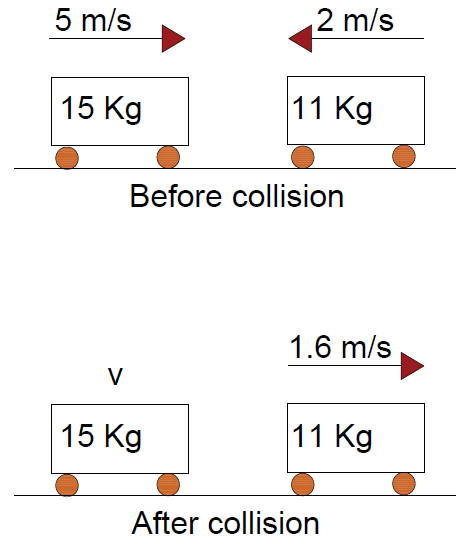
Example 1: two carts
A 15 kg wooden cart moving at 5.0 m/s to the right collides with an 11 kg cart moving at 2.0 m/s to the left.
After the collision, the 11 kg cart moves at 1.6 m/s to the right. Calculate the final velocity of the 15 kg cart.
Take right as positive.
Momentum before the collision
(15 × 5.0) + (11 × -2.0)
= 75 - 22
= 53 kg m/s
Momentum after the collision
(15 × v) + (11 × 1.6)
= 15v + 17.6
Apply conservation of momentum
15v + 17.6 = 53
15v = 35.4
v = 35.4 ÷ 15
v = 2.36 m/s to the right
Example 2: trucks couple together
A 60 kg model truck moving at 3.0 m/s collides and couples with a stationary 30 kg model truck. The two trucks move together with the same final velocity, v.
Momentum before the collision
(60 × 3.0) + (30 × 0)
= 180 + 0
= 180 kg m/s
Momentum after the collision
(60 + 30)v
= 90v
Apply conservation of momentum
90v = 180
v = 180 ÷ 90
v = 2.0 m/s in the original direction
Cambridge-style practice
Practice questions
Define momentum.
Momentum is the product of mass and velocity.
A 1200 kg car travels at 15 m/s. Calculate its momentum.
p = mv
p = 1200 × 15
p = 18 000 kg m/s
A resultant force of 40 N acts for 0.30 s. Calculate the impulse.
impulse = FΔt
impulse = 40 × 0.30
impulse = 12 N s
An object's momentum changes from 6.0 kg m/s to 18 kg m/s in 0.40 s. Calculate the resultant force.
Δp = 18 - 6.0 = 12 kg m/s
F = Δp ÷ Δt
F = 12 ÷ 0.40
F = 30 N
A 2.0 kg trolley moving at 4.0 m/s collides and couples with a stationary 3.0 kg trolley. Calculate their common velocity.
Total momentum before = (2.0 × 4.0) + (3.0 × 0)
Total momentum before = 8.0 kg m/s
Total mass after = 2.0 + 3.0 = 5.0 kg
8.0 = 5.0v
v = 8.0 ÷ 5.0
v = 1.6 m/s in the original direction
Take right as positive. A 4.0 kg trolley moving at +3.0 m/s collides with a 2.0 kg trolley moving at -1.0 m/s. They couple. Calculate their final velocity.
Total momentum before = (4.0 × 3.0) + (2.0 × -1.0)
Total momentum before = 12 - 2.0 = 10 kg m/s
Total mass after = 4.0 + 2.0 = 6.0 kg
10 = 6.0v
v = 10 ÷ 6.0
v = +1.7 m/s, so the trolleys move to the right
Explain why increasing the stopping time reduces the average force when the momentum change remains the same.
F = Δp ÷ Δt
The change in momentum remains constant.
Increasing Δt decreases the value of the force.
Therefore, a longer stopping time produces a smaller average resultant force.
Tap a card to reveal the answer