Cambridge IGCSE Physics 0625
1.7 Energy, work and power
Detailed Core and Extended notes on energy stores and transfers, conservation, work, energy resources, efficiency and power.
2026-2028 syllabus
Syllabus checklist
1.7.1 Energy
Core
- State that energy may be stored as kinetic, gravitational potential, chemical, elastic (strain), nuclear, electrostatic and internal (thermal).
- Describe how energy is transferred between stores during events and processes, including mechanically by forces, electrically by currents, by heating and by electromagnetic, sound and other waves.
- Know and apply the principle of conservation of energy to simple examples, including simple flow diagrams.
Supplement
- Recall and use the equation for kinetic energy.
- Recall and use the equation for the change in gravitational potential energy.
- Apply conservation of energy to complex examples involving multiple stages, including interpreting Sankey diagrams.
1.7.2 Work
Core
- Understand that mechanical or electrical work done is equal to the energy transferred.
- Recall and use the equation for mechanical working: W = Fd = ΔE.
1.7.3 Energy resources
Core
- Describe how useful energy may be obtained or electrical power generated from fossil fuels, biofuels, water, geothermal resources, nuclear fuel, sunlight, infrared and other electromagnetic waves, and wind.
- Describe the advantages and disadvantages of each method in terms of renewability, availability, reliability, scale and environmental impact.
- Understand qualitatively the concept of efficiency of energy transfer.
Supplement
- Know that radiation from the Sun is the main source of energy for all energy resources except geothermal, nuclear and tidal.
- Know that energy is released by nuclear fusion in the Sun.
- Know that research is being carried out to investigate how energy released by nuclear fusion can be used to produce electrical energy on a large scale.
- Define efficiency using useful energy output or useful power output divided by total input, and recall and use these equations.
1.7.4 Power
Core
- Define power as work done per unit time and as energy transferred per unit time; recall and use the equations P = W ÷ t and P = ΔE ÷ t.
Key scientific language
Definitions
Energy
A quantity stored in a system that can be transferred between stores. Energy is measured in joules (J).
Work done
The energy transferred when a force moves an object through a distance in the direction of the force.
Power
The rate of doing work or transferring energy. Power is measured in watts (W).
Efficiency
The fraction of total input energy or power transferred to the intended useful output.
Renewable resource
An energy resource naturally replenished and not permanently used up on a human timescale.
Non-renewable resource
A finite energy resource used more quickly than natural processes can replace it.
Dissipated energy
Energy transferred to less useful stores, usually the internal energy of the surroundings.
Closed system
A system across whose boundary no energy is transferred.
Core: 1.7.1
Energy stores and transfers
The seven energy stores
Energy is stored in systems. During an event or process, energy is transferred from one store to another. Energy does not disappear when it is used.
Four ways energy is transferred
-
Mechanically, when a force does work.
Pushing a box transfers energy from the chemical store in a person's muscles to the kinetic store of the box. Friction transfers some energy to internal stores.
-
Electrically, when an electric current does work.
In a battery-powered device, energy is transferred electrically from the battery's chemical store to other stores in the device.
-
By heating.
Energy is transferred from a hotter object or region to a cooler one. Heating water in a kettle increases the water's internal energy store.
-
By electromagnetic, sound or other waves.
Electromagnetic waves transfer energy from the Sun to Earth. Vibrating guitar strings transfer energy to the surroundings by sound waves.
Principle of conservation of energy
Energy cannot be created or destroyed. It can only be transferred between stores. The total energy in a closed system therefore remains constant.
In real processes, some energy is transferred to the internal energy stores of objects and the surroundings by friction, air resistance, electrical resistance and other unwanted processes.
This energy is often described as dissipated or wasted because it is less useful, but it has not been destroyed.
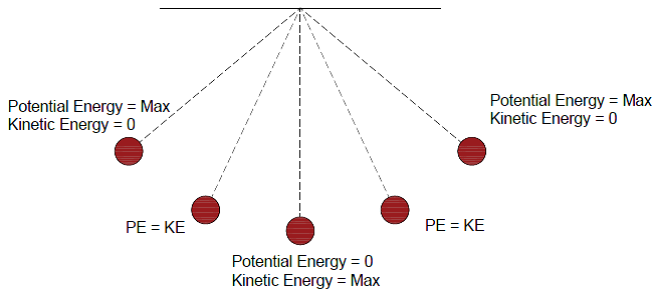
Pendulum example
At either highest point, the pendulum bob is momentarily stationary. Its kinetic energy is zero and its gravitational potential energy is greatest.
As the bob swings down, energy is transferred from its gravitational potential store to its kinetic store.
At the lowest point, the bob has maximum speed and maximum kinetic energy.
As the bob rises, energy is transferred from its kinetic store back to its gravitational potential store.
In a real pendulum, air resistance and friction transfer energy to internal stores. Each swing therefore reaches a slightly smaller height.
Roller-coaster example
At the highest point, a roller coaster has a large gravitational potential energy store. If it starts from rest, its kinetic energy is initially zero.
As it descends, its gravitational potential energy decreases and its kinetic energy increases, so the coaster speeds up.
As it climbs another hill, kinetic energy is transferred back to gravitational potential energy.
Friction and air resistance transfer some energy to internal stores and by sound. Without an additional energy transfer, the coaster cannot rise higher than its starting point.
Energy-flow diagrams
A flow diagram shows the initial energy store, the transfer pathway and the final energy stores. The total energy at the start equals the total energy at the end.
For an electrical appliance, the electrical input may be transferred to useful light and unwanted heating. The unwanted heating is not lost energy; it has been transferred to the surroundings.
Supplement: 1.7.1
Energy calculations and Sankey diagrams
Kinetic energy
Kinetic energy is the energy stored by a moving object. It depends on the object's mass and on the square of its speed.
Kinetic energy
- Ek is kinetic energy in joules (J).
- m is mass in kilograms (kg).
- v is speed in metres per second (m/s).
Doubling the mass doubles the kinetic energy when speed remains constant. Doubling the speed makes the kinetic energy four times greater because speed is squared.
Worked example
A 1200 kg car travels at 20 m/s.
Ek = 0.5 × 1200 × 202
Ek = 0.5 × 1200 × 400
Ek = 240 000 J
Change in gravitational potential energy
When an object moves vertically in a gravitational field, its gravitational potential energy changes. Raising an object increases this store, while lowering it decreases this store.
Change in gravitational potential energy
- ΔEp is the change in gravitational potential energy in J.
- m is mass in kg.
- g is gravitational field strength in N/kg.
- Δh is the vertical change in height in m.
Use the vertical height change rather than the distance travelled along a slope.
Worked example
A 5.0 kg object is raised through 8.0 m. Use g = 9.8 N/kg.
ΔEp = 5.0 × 9.8 × 8.0
ΔEp = 392 J
Multi-stage energy transfers
Complex processes may involve several stages. For example, a fuel's chemical energy may heat water, the steam may turn a turbine, and the turbine may drive a generator.
Apply conservation of energy at every stage and across the complete process. The total output energy equals the total input energy, although the useful fraction often becomes smaller at each stage.
Sankey diagrams
A Sankey diagram represents energy or power transfers using arrows. The width of each arrow is proportional to the amount of energy or power it represents.
The main forward arrow normally represents the useful output. Side arrows represent dissipated outputs, usually energy transferred to internal stores or by sound.
- 1
Read the total input from the incoming arrow.
- 2
Identify the useful output and all dissipated outputs.
- 3
Use total input = useful output + total dissipated output.
- 4
Check that the widths and values of all output arrows add to the input.
- 5
Calculate efficiency using useful output divided by total input.
Worked example
A machine receives 800 W and transfers 520 W usefully.
Dissipated power = 800 - 520
Dissipated power = 280 W
Core: 1.7.2
Work
Mechanical and electrical work
Mechanical work is done when a force moves an object through a distance in the direction of the force. The work done equals the energy transferred.
The greater the force, the more work is done over the same distance. The greater the distance moved, the more work is done by the same force.
If a force acts at right angles to the movement, this simple equation does not use that force because there is no displacement in its direction.
Electrical work is done when an electrical current transfers energy. Mechanical work, electrical work and energy transferred are all measured in joules.
Mechanical working
- W is work done in joules (J).
- F is force in newtons (N).
- d is distance moved in the direction of the force in metres (m).
- ΔE is energy transferred in joules (J).
Forklift worked example
A forklift raises a crate of weight 640 N vertically through 3.5 m in 4.0 s.
Calculate the useful work done
W = Fd
W = 640 × 3.5
W = 2240 J
Energy transferred through unwanted processes
Not all input energy is transferred usefully to the crate's gravitational potential store. Energy may also be transferred:
- to internal stores by electrical resistance;
- to internal stores by friction in moving parts;
- by sound;
- in lifting or moving parts of the forklift itself.
Core: 1.7.3
Energy resources
Boilers, turbines and generators
In many power stations, an energy resource heats water in a boiler. The water becomes high-pressure steam that turns a turbine. The rotating turbine drives a generator, which transfers energy electrically.
Hydroelectric, tidal, wave and wind systems use moving water or air to turn turbines without first heating water. Solar cells transfer energy directly from sunlight to electrical energy and do not require a turbine or generator.
Fossil fuels
Coal, oil and natural gas contain chemical energy. The fuel is burned in a boiler to heat water. Steam turns a turbine connected to a generator.
Advantages: fuel can be stored; output is controllable and reliable; established stations generate electricity on a large scale.
Disadvantages: non-renewable; combustion releases carbon dioxide and air pollutants; mining and drilling damage habitats.
Biofuels
Biofuels are made from recently living material such as crops, wood and biological waste. Biomass may be burned to heat water, producing steam for a turbine and generator.
Advantages: renewable when material is replanted; can use waste; growing plants absorb carbon dioxide.
Disadvantages: burning releases carbon dioxide; crops require land and water; plantations may compete with food production or cause deforestation.
Water: hydroelectric, tidal and wave
Hydroelectric: water stored behind a dam has gravitational potential energy. Falling water turns turbines and generators.
Tidal: predictable seawater movement through a barrage or around underwater turbines drives generators.
Wave: moving waves operate mechanical devices that drive generators.
Advantages: renewable; no fuel is burned; hydroelectric and tidal systems can produce large outputs; tides are predictable.
Disadvantages: expensive construction; limited suitable locations; dams and barrages disrupt habitats; wave output varies with weather.
Geothermal resources
Thermal energy from hot rocks beneath Earth's surface heats water. Hot water may be used directly for heating, or steam may turn a turbine and generator.
Advantages: renewable; reliable continuous output; low operating emissions; not weather-dependent.
Disadvantages: useful sites are mainly in geologically active regions; drilling is expensive; underground gases or minerals may reach the surface.
Nuclear fuel
Nuclear fission in a reactor transfers energy from the nuclear store of uranium or plutonium. The energy heats water, and steam drives a turbine and generator.
Advantages: reliable large-scale output; small amounts of fuel release large amounts of energy; little carbon dioxide is released during operation.
Disadvantages: fuel is non-renewable; stations are expensive; radioactive waste requires secure long-term storage; accidents may release radioactive material.
Solar cells
Photovoltaic cells transfer energy from sunlight directly to electrical energy. Cells may be connected into panels and large arrays.
Advantages: renewable; no fuel cost; no emissions during operation; silent; useful in remote areas; available on different scales.
Disadvantages: output falls in cloudy conditions and stops at night; storage or backup is needed; large outputs require large surface areas.
Solar heating and wind
Solar thermal panels absorb infrared and other electromagnetic radiation from the Sun and transfer energy by heating water. They do not directly generate electricity.
Uneven solar heating of Earth's surface creates moving air. Wind turns turbine blades connected to generators.
Advantages: renewable; no fuel is burned; wind farms can operate on land or offshore; solar heating reduces demand for other fuels.
Disadvantages: both depend on weather; wind output varies; turbines may produce noise and visual impact and affect wildlife.
Choosing an energy resource
No resource is best in every situation. A complete comparison should consider:
- whether the resource is renewable;
- local availability;
- reliability and weather dependence;
- the required scale of power generation;
- construction and operating costs;
- environmental effects.
Qualitative understanding of efficiency
Efficiency measures how successfully a device or process transfers input energy to the intended useful output.
In any real energy transfer, some energy is usually dissipated to unwanted stores, commonly through heating or sound.
A more efficient device transfers a larger fraction of its input energy usefully and a smaller fraction to unwanted stores.
An electric heater may be almost 100% efficient for heating a room because nearly all its electrical input increases the internal energy of the room. A car engine is less efficient because considerable energy is dissipated through heating and sound.
Supplement: 1.7.3
The Sun, fusion and efficiency
The Sun as the main source of energy
Radiation from the Sun is the main source of energy for most energy resources on Earth.
- Solar: energy arrives directly as electromagnetic radiation.
- Wind: uneven solar heating causes atmospheric movement.
- Waves: winds transfer energy to the surface of the sea.
- Hydroelectric: solar heating drives the water cycle, raising water to higher gravitational potential energy stores.
- Biomass: plants obtain energy from sunlight during photosynthesis.
- Fossil fuels: their chemical energy originally came mainly from ancient organisms that obtained energy from sunlight.
The syllabus exceptions are geothermal, nuclear and tidal. Geothermal energy comes from Earth's interior, nuclear energy comes from atomic nuclei, and tidal energy mainly comes from gravitational interactions involving Earth and the Moon.
Nuclear fusion in the Sun
The Sun releases energy through nuclear fusion. In fusion reactions, light nuclei combine to form heavier nuclei.
In the Sun, hydrogen nuclei ultimately combine to form helium. This process releases a very large amount of energy that eventually reaches Earth as electromagnetic radiation.
Research into fusion electricity
Scientists are investigating how energy released by nuclear fusion could be used to generate electricity on a large scale.
Fusion fuel could be widely available, and fusion could produce large energy outputs without the carbon dioxide released by burning fossil fuels.
However, fusion requires extremely high temperatures and suitable confinement. Maintaining a controlled reaction that provides a reliable net energy output remains technically difficult, so research is continuing.
Calculating efficiency using energy
Energy efficiency
Worked example
A machine receives 100 J of energy and transfers 40 J usefully.
efficiency = 40 ÷ 100 × 100%
efficiency = 40%
The remaining 60 J is transferred to unwanted stores, often by heating or sound.
Calculating efficiency using power
Power efficiency
Efficiency has no unit. It may be written as a decimal between 0 and 1 or as a percentage between 0% and 100%.
Efficiency cannot be greater than 100% because this would mean that more energy leaves a system than enters it, which would break the principle of conservation of energy.
Core: 1.7.4
Power
Power is a rate
Power is the rate of doing work or the rate of transferring energy.
The greater the work done in a given time, the greater the power. For the same work done, completing the work in a shorter time means greater power.
The unit of power is the watt (W). One watt is one joule per second: 1 W = 1 J/s.
Power from work done
- P is power in watts (W).
- W is work done in joules (J).
- t is time in seconds (s).
Power from energy transferred
- ΔE is energy transferred in J.
- t is time in s.
- P is power in W.
Forklift power calculation
The forklift transfers 2240 J usefully in 4.0 s.
P = W ÷ t
P = 2240 ÷ 4.0
P = 560 W
Cambridge-style practice
Practice questions
Name the seven energy stores.
Kinetic, gravitational potential, chemical, elastic (strain), nuclear, electrostatic and internal (thermal).
Describe the energy transfers as a pendulum moves from its highest point to its lowest point.
- The gravitational potential energy store decreases.
- The kinetic energy store increases as the bob accelerates.
- Some energy is transferred to internal stores by air resistance and friction.
A 75 N force moves a box 4.0 m in the direction of the force. Calculate the work done.
W = Fd
W = 75 × 4.0
W = 300 J
A motor transfers 12 000 J in 30 s. Calculate its power.
P = ΔE ÷ t
P = 12 000 ÷ 30
P = 400 W
Explain why energy described as wasted has not disappeared.
Energy is conserved and cannot be destroyed.
It has been transferred to less useful stores, usually the internal energy of the surroundings.
Give two advantages and two disadvantages of hydroelectric power.
Advantages: renewable; no fuel is burned; output can be reliable and large-scale.
Disadvantages: high construction cost; limited suitable locations; flooding and habitat disruption.
Any two valid points from each group gain credit.
Calculate the kinetic energy of a 1200 kg car travelling at 20 m/s.
Ek = 0.5mv2
Ek = 0.5 × 1200 × 202
Ek = 240 000 J
A 5.0 kg object is raised through 8.0 m. Use g = 9.8 N/kg to calculate its increase in gravitational potential energy.
ΔEp = mgΔh
ΔEp = 5.0 × 9.8 × 8.0
ΔEp = 392 J
A machine receives 2500 J and transfers 1750 J usefully. Calculate its efficiency and dissipated energy.
efficiency = useful energy output ÷ total energy input × 100%
efficiency = 1750 ÷ 2500 × 100%
efficiency = 70%
dissipated energy = 2500 - 1750
dissipated energy = 750 J
A device has an input power of 800 W and an efficiency of 65%. Calculate its useful power output.
0.65 = useful power output ÷ 800
useful power output = 0.65 × 800
useful power output = 520 W
Tap a card to reveal the answer